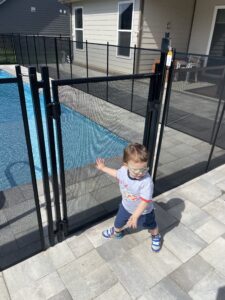

Keeping your pool safe is more than good practice — it’s smart planning.
In Tennessee, pool safety isn’t dictated by one statewide law, but there are clear expectations, local regulations, and widely accepted safety standards that homeowners should follow to protect children, pets, and neighbors.
This guide will walk you through:
What Tennessee requires (and doesn’t require)
What local jurisdictions in Middle Tennessee expect
Recommended safety measures
Practical compliance tips
Do Tennessee Pool Fence Laws Exist?
Unlike some states, Tennessee does not have a single, comprehensive statewide pool fence law that mandates exactly how pool barriers must be built. However, that doesn’t mean you’re free to install whatever you want.
Many cities, counties, and local building codes adopt barrier requirements based on internationally recognized standards, including:
ASTM International standards (e.g., ASTM F2286 for removable mesh fences)
International Swimming Pool and Spa Code (ISPSC) guidelines
These standards are widely used because they have been shown to significantly reduce drowning risk.
Why Local Codes Matter in Tennessee
In Middle Tennessee — including cities like Franklin, Brentwood, Murfreesboro, and Nashville — pool barrier requirements are usually enforced at the city or county level through building codes or permitting processes.
Local codes may specify:
✔ Minimum fence height
✔ Gate type requirements
✔ Latch positioning
✔ Barrier materials
✔ Clearances from the pool
Even if your area does not require a permit, these safety provisions still apply for homes with pools.
Important: Some homeowner associations (HOAs) also have their own fence requirements — always check your HOA rules first.
Common Tennessee Pool Barrier Standards
Here are the most widely accepted safety elements most local codes and guidelines follow:
🔹 Minimum Fence Height
Most local codes and safety standards require at least 4 feet (48 inches) of vertical barrier between the ground and the top of the pool fence.
🔹 Fence Materials
Mesh pool fences
Aluminum fencing
Vinyl picket fencing
All acceptable if they meet code clearance and safety requirements.
🔹 Gate Requirements
Pool gates must typically be:
✔ Self‑closing
✔ Self‑latching
✔ Latch positioned at least 54” from the ground (out of small children’s reach)
🔹 Barrier Placement
Fence must fully enclose the pool perimeter with no gaps or openings that a child could squeeze through.
🔹 No Climbable Objects
No structural elements that could help children climb over the barrier.
What About Pool Covers & Safety Nets?
Pool safety covers, including removable mesh safety covers, are excellent additional layers of protection and are often recommended for homes with small children.
However:
👉 Pool covers do not replace the requirement for a physical barrier if local codes require it.
Think of covers as a second layer of defense — not a substitute for a fence.
Middle Tennessee Cities & Barrier Expectations
Here’s how some local areas approach pool safety laws:
Franklin, TN
Pool permits may require a fence that meets ASTM standards and includes a self‑closing gate.
Brentwood, TN
City code references minimum height and gate requirements similar to ISPSC standards.
Murfreesboro, TN
County and city codes typically follow standard barrier provisions used across residential pools.
Because each jurisdiction can vary, always check with your local codes or your pool contractor before building.
Insurance & Real‑World Requirements
Even if your city doesn’t strictly enforce a pool fence law:
✔ Your homeowners insurance carrier may require a barrier to reduce liability
✔ Real estate transactions often require proof of safety measures
✔ Pediatric safety organizations recommend a pool barrier
This means installing a proper fence is not just about compliance — it’s about protecting your family and your investment.
Industry Safety Recommendations That Influence Local Codes
Safety organizations widely support barriers around residential pools:
Consumer Product Safety Commission: recommends four layers of protection — including a barrier
American Academy of Pediatrics: emphasizes barriers, alarms, and supervision
Pool fence installations that meet ASTM or ISPSC standards follow these recommendations and often align with local requirements.
Pool Safety Solutions Advantage
We don’t just install fences — we engineer solutions built for lasting safety and peace of mind:
Lifetime warranty on all fences
200lb strength, exceeding most local requirements
Custom sizes & removable options for every pool and yard
Practical Tips for Tennessee Pool Owners
✅ 1. Choose the Right Fence Type
Removable mesh fences have become the safest and most code‑friendly option.
✅ 2. Get Permits if Required
If your city requires a building permit, get it before installing the fence.
✅ 3. Install Self‑Closing, Self‑Latching Gates
This increases safety and often satisfies code language.
✅ 4. Avoid Climbable Landscaping Around the Fence
Keep tables, planters, and other objects away from the barrier.
✅ 5. Keep Documentation
Pictures, invoices, and installation details can help with insurance and resale.
How Pool Safety Solutions Can Help
At Pool Safety Solutions, we:
🔹 Install code‑compliant pool safety fences
🔹 Follow ASTM and local safety standards
🔹 Offer industry‑tested removable mesh fences
🔹 Provide lifetime workmanship guarantees
🔹 Serve Middle Tennessee including Franklin, Brentwood, Murfreesboro and more
If you’d like a quote or expert recommendation for your pool, we’d be glad to help.
Frequently Asked Questions (FAQ)
Q: Do all Tennessee cities require a pool fence?
A: Not all have specific ordinances, but most adopt general safety standards that include barrier requirements.
Q: Can a pool cover replace a fence?
A: No. Pool covers are a supplemental safety layer but do not replace a pool fence when codes require a barrier.
Q: What height should my pool fence be?
A: Most local codes and safety standards recommend a minimum of 48″ (4 feet).
Q: Do gates matter?
A: Yes — self‑closing, self‑latching gates are a standard safety requirement.
Q: Does Pool Safety Solutions offer lifetime warranties?
A: Absolutely. All our fences come with a lifetime warranty and are built to withstand 200lb forces.
Bottom Line
Even though Tennessee doesn’t have a single statewide pool fence law, local codes and widely adopted standards make barriers essential for safety, compliance, insurance, and resale value. A properly built pool fence protects your family — and makes your backyard space legally and practically safer.